Faster Approvals
Submit a compliant, thorough report the first time, reducing council requests for further information (RFIs).
Professional, AQF Level 5 Arborist Reports for council permits, development applications, and risk assessments.
Consulting services throughout Kallista and the Dandenongs.
Whether you are renovating, building, or dealing with a hazardous tree, an Arborist Report Kallista is usually the first step to navigating local planning laws.
In Kallista, almost every property is subject to strict planning controls protecting the forest character. A well-prepared arborist report is the key to proving that your proposed tree removal or building works are safe, justified, and compliant.
Submit a compliant, thorough report the first time, reducing council requests for further information (RFIs).
Clear Tree Protection Zones (TPZ) prevent accidental damage to retained trees during construction.
Formal documentation limits your liability in neighbour disputes or insurance claims.
We discuss your goals—whether it's building a deck, removing a tree, or assessing a hazard.
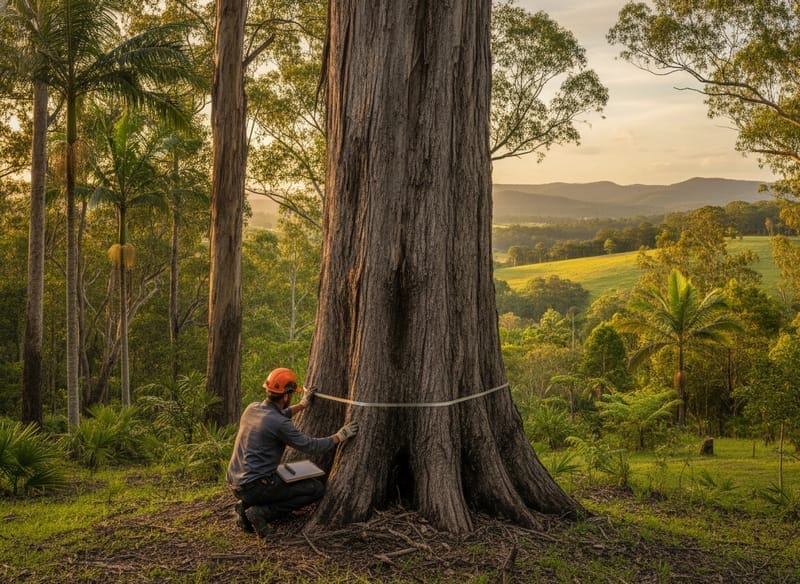
Our consulting arborist visits your Kallista property to measure, photograph, and assess the trees.
We calculate Tree Protection Zones (TPZ) and Structural Root Zones (SRZ) as per AS4970.
We compile a detailed, independent written report addressing all council requirements.
You receive the final report, and we advise on the next steps for your council application.
Living and building in the Dandenong Ranges requires a careful balance between preserving our stunning natural environment and managing structural risk. Whether you are subdividing a sloping block, planning an extension on a 1970s character home, or managing a towering Mountain Ash that looks unstable, a professional Arborist Report Kallista is often the very first mandatory step. Our team of local arborists understands the specific demands of this steep, densely vegetated region and the stringent requirements of the local planning scheme.
Properties in Kallista and surrounding suburbs like The Patch, Sherbrooke, and Belgrave are heavily regulated by Yarra Ranges Shire Council overlays. You cannot simply remove a large canopy tree without proper, scientifically backed documentation. We provide AQF Level 5 consulting arborist reports that satisfy all council requirements, identify genuine hazards before they impact your property, and give you a clear, compliant pathway forward for your development or risk mitigation project.
When a property owner or developer tries to bypass a formal arborist assessment, or relies on an unqualified tree lopper to write a quick "letter of support," the results are inevitably expensive and frustrating. Yarra Ranges Shire Council planners will outright reject development applications or tree removal permits if the supporting documentation is not prepared by a certified AQF Level 5 consulting arborist. This can stall your building project for months, costing you thousands in holding costs and contractor delays. Beyond council rejections, an inadequate assessment puts your property and family at immense physical risk. The Dandenong Ranges experience severe winter cold fronts and fierce wind events—the June 2021 storms that flattened thousands of trees across Kalorama, Olinda, and Sassafras are a stark reminder of this reality. A poorly conducted Visual Tree Assessment (VTA) by an untrained eye might easily miss critical structural defects, fungal decay, or root plate instability in a massive Messmate Stringybark overhanging your roof. Our consulting arborists solve this problem by delivering comprehensive, AS4970 and AS4373-compliant reports. We map the site accurately, calculate precise Safe Useful Life Expectancy (SULE) ratings, and detail every structural flaw using industry-standard diagnostic tools. This dual focus ensures your development application moves smoothly through the council approval process, while giving you absolute peace of mind that hidden hazards have been identified.
We provide a comprehensive range of diagnostic and consulting services. Our reports are heavily structured to meet the precise technical criteria demanded by local planning departments, insurers, and civil engineers.
Required by Yarra Ranges Council when a proposed development impacts protected vegetation. We provide a complete tree inventory, measuring Diameter at Breast Height (DBH), canopy spread, and Safe Useful Life Expectancy (SULE). The report outlines clear retention values and removal recommendations aligned with local overlays.
Essential for protecting retained trees during construction. We mathematically calculate Tree Protection Zones (TPZ) and Structural Root Zones (SRZ). The report details mandatory fencing, root mapping procedures, ground protection measures, and stages of the build requiring on-site arborist supervision.
Conducted using Visual Tree Assessment (VTA) and QTRA principles. We inspect the tree for biomechanical defects, decay brackets, and canopy dieback. We evaluate the likelihood of failure against the consequence to nearby targets (homes, driveways, powerlines) to provide actionable risk mitigation strategies.
When a protected tree needs to be removed due to poor health, structural failure, or property damage. We compile photographic evidence and diagnostic data to justify the removal under the Significant Landscape Overlay (SLO) or Erosion Management Overlay (EMO), including recommendations for appropriate offset replanting.
Delivering an accurate, council-ready document begins long before we set foot on your property. Our team first reviews your site's specific planning controls. We interrogate the Yarra Ranges Planning Scheme to identify the exact schedules of the Significant Landscape Overlay (SLO), Erosion Management Overlay (EMO), and Bushfire Management Overlay (BMO) that apply to your address. This ensures our field data collection targets the precise metrics council will demand. Next, our consulting arborist visits your site to conduct a thorough physical inspection. We utilize specialized equipment, including nylon diameter tapes, clinometers for height estimation, and sounding mallets to detect hollows. We meticulously map the position of the trees relative to existing structures and proposed building envelopes. When you book an Arborist Report Kallista, we guarantee that every local environmental factor—from the steep gully winds channeling through your block to the soil moisture retention on your slopes—is factored into our structural evaluation. Once the field data is secured, we return to the office to draft your comprehensive PDF report. This document includes high-resolution annotated photography, highly accurate site maps detailing TPZ and SRZ radii, and unambiguous recommendations for retention, pruning, or removal. The final report is delivered to you fully signed, insured, and ready for immediate submission to the council planning portal.
Consulting arboriculture is a highly regulated discipline, and our reporting adheres strictly to the authoritative Australian Standards. For development and construction sites, our calculations and protection strategies are entirely governed by AS4970 — Protection of Trees on Development Sites. When specifying canopy management or risk mitigation, we mandate that all works comply with AS4373 — Pruning of Amenity Trees.
Crucially, all our formal reporting is completed by an AQF Level 5 (Diploma of Arboriculture) qualified consulting arborist, the mandatory benchmark accepted by the Yarra Ranges Shire Council. As an established business, we are fully covered by Professional Indemnity insurance for all diagnostic consulting, alongside comprehensive Public Liability and WorkCover for our operational tree teams.
The Dandenong Ranges present a highly complex operating environment that off-the-mountain consultants frequently misunderstand. In Kallista, the combination of towering indigenous canopy, steep hinterland terrain, and layered council controls makes tree management intensely technical.
Under the dominant Significant Landscape Overlay (SLO), you generally require a permit to remove any substantial tree with a trunk circumference over 1.1 metres. However, Kallista properties frequently fall under the Erosion Management Overlay (EMO) due to landslip-prone gullies. Removing large Mountain Ash or Mountain Grey Gum on these slopes requires specialised reporting to assure council that root decomposition will not trigger soil failure.
Furthermore, balancing your clearing rights under the Bushfire Management Overlay (BMO) with native vegetation protections under Clause 52.17 requires expert local interpretation. We know exactly how Yarra Ranges planners assess these intersecting rules, ensuring your report addresses every local nuance without triggering costly requests for further information.
Once your report is submitted and your council permits or building approvals are granted, the critical next step is executing the physical requirements. If your report outlines a Tree Protection Plan, you must install the specified TPZ chain-mesh fencing and trunk armor before any excavators or delivery trucks enter your site. If the report specifies risk mitigation pruning, deadwooding, or complete removal, our AQF Level 3 climbing arborists can seamlessly take over and carry out the works exactly as the consulting arborist prescribed. For large retained trees with monitored defects, we strongly advise scheduling a follow-up Visual Tree Assessment every two to three years, or after a major winter storm, to ensure your property remains perfectly safe.
The cost of an arborist report depends heavily on the scope and the number of trees being assessed.
We provide a fixed-fee proposal for all consulting work before any site visits occur.
Providing AQF Level 5 consulting across:
Contact our AQF Level 5 consulting arborist today for a fixed-price proposal.
Request a Proposal